Free Things to Do in Victoria BC (and When It's Worth Upgrading to a Tour)
Victoria is unusually kind to a thin wallet. The best part of the city, the harbour and the streets around it, costs nothing to walk, and the things that do charge admission mostly sit outside that core.
At a glance: A great deal.
What Victoria costs, from free upward
Listed prices in US dollars from the operators' own tour listings, alongside the free self-guided version of a Victoria day. Prices move, so check the current figure on the listing before booking.
What can you actually do in Victoria for free?
A great deal. The Inner Harbour causeway, Beacon Hill Park, the Dallas Road waterfront, Chinatown and Fan Tan Alley, Fisherman's Wharf's float-home docks and the harbour's street performers all cost nothing. Between them they fill a full day and cover most of what people photograph in Victoria anyway.
The reason the free list here is so strong is geography. Victoria's landmarks cluster around one harbour, and the harbour is public space. In a city where the sights were spread across ten kilometres, a free day would mean a lot of walking between disappointments. Here it means one continuous walk with something on either side of you the whole way.
What follows is the honest list. We have separated the genuinely free from the almost-free, because a day that quietly turns into $60 of coffee and admission is not really a free day.
| What | Cost | How long | Worth it? |
|---|---|---|---|
| Inner Harbour causeway and waterfront | Free | 30 to 90 minutes | The single best free thing in the city |
| Street performers on the causeway | Free, tip if you stop | As long as you like | Best in summer, patchy in winter |
| Beacon Hill Park | Free | 1 to 2 hours | Big, varied, and right beside downtown |
| Dallas Road waterfront walk | Free | 45 to 90 minutes | Open sea views, exposed to wind |
| Chinatown and Fan Tan Alley | Free to walk | 30 to 60 minutes | Small, dense, genuinely historic |
| Fisherman's Wharf float homes | Free to walk the docks | 30 to 45 minutes | The food there is not free |
| Old Town and the historic alleyways | Free | 45 minutes | Better with a guide, fine without |
| Legislative Buildings exterior and grounds | Free | 20 to 30 minutes | Lit at night, worth a second visit after dark |
Add those up and you have six or seven hours without spending anything. That is a real day in a real city, not a consolation prize.
Is the Inner Harbour worth an afternoon on its own?
Yes. The harbour is the centre of Victoria in a literal sense: the Legislative Buildings on one side, the Fairmont Empress on the other, seaplanes landing in the middle, ferries crossing it, and a curved causeway where street performers set up through the warmer months. You can spend three hours here without paying for anything.
The causeway is the part to slow down for. It steps down toward the water in a broad arc, which turns it into a natural amphitheatre, and buskers work it in rotation through the summer. Some are very good. Tipping is the convention if you stop and watch, but nobody collects a fee to be there.
Two free viewing habits pay off. First, come back after dark: the Legislative Buildings are outlined in lights and the harbour is a different place at night, which is why our guide to things to do in Victoria after dark starts here. Second, watch the seaplanes. They land and take off from the harbour itself throughout the day, close enough that you can follow a whole approach from the causeway rail.
The Legislative Buildings themselves sometimes run free public tours through the year. Availability changes with the parliamentary calendar and the season, so check what is running before you build an hour around it rather than turning up expecting one. Tourism Victoria lists what is on around the harbour week by week, and the City of Victoria official website is the place to check park and public-space information if a festival or closure might affect your plans.
| When | What the harbour is doing | Why bother |
|---|---|---|
| Early morning | Still, empty, seaplanes warming up | The best light and no crowds at all |
| Late morning | Tour groups gathering, ferries crossing | Good people-watching, busy causeway |
| Midday in summer | Buskers working the causeway steps | The free entertainment window |
| Late afternoon | Boats coming in, light going gold | The photograph most people go home with |
| After dark | Legislative Buildings outlined in lights | A different city, and still free |
None of that needs a plan. Turning up twice, once in daylight and once at night, is the whole trick, and the second visit takes ten minutes.
What is there to do in Beacon Hill Park?
Beacon Hill Park is free, large, and sits at the edge of downtown rather than out in the suburbs, which is what makes it useful. Inside there are gardens, ponds, open lawns, a children's area, and one of the world's tallest totem poles, with the Dallas Road waterfront running along its southern edge.
The walk from the Inner Harbour to the park takes about fifteen minutes, and the natural route continues straight through the park to the sea. That sequence, harbour to park to open water, is the free spine of a Victoria day and it works in either direction.
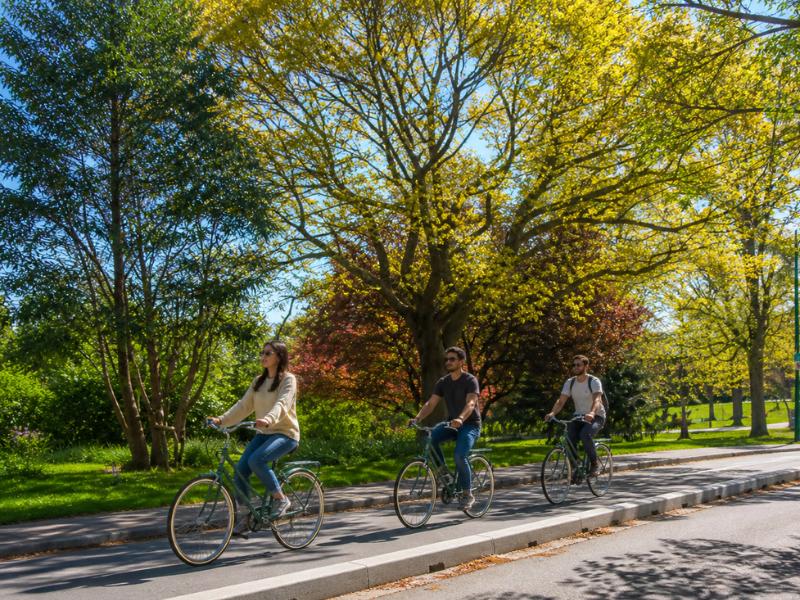
What people miss is the exposure at the far end. The park is sheltered and the Dallas Road clifftop is not: the wind comes straight off the Strait of Juan de Fuca and the temperature drops noticeably in the last two hundred metres. Locals cycle it year-round with a windbreaker. Visitors in a summer shirt regret it. Cyclists on the guided cycling tour through Victoria's neighbourhoods ride this exact stretch on a 6.8-mile loop, and their guides warn about the same micro-climate shift between sheltered Fernwood and the open waterfront.
Can you walk Chinatown and Fan Tan Alley for free?
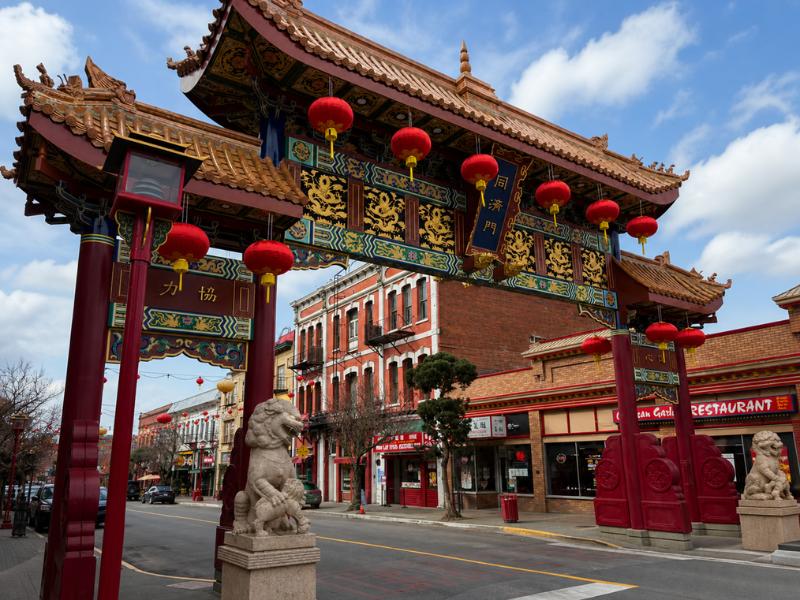
Yes, and it is one of the highest-value free half-hours in the city. Victoria's Chinatown is the oldest in Canada, compact enough to cover on foot in half an hour, and Fan Tan Alley running off Fisgard Street is one of the narrowest commercial streets on the continent. Walking it costs nothing. Shopping in it does not.
Go at a time that suits what you want. Mid morning is quiet and photographic. Lunchtime is busy and alive, with the bakeries and BBQ pork bun counters doing steady trade, and that is when the neighbourhood feels like a working part of the city rather than a heritage set piece.
The free version is a walk. The paid version adds the history and the eating, which is a genuinely different thing: guided food walks through this area stop at six to eight vendors and the tastings add up to a full lunch. If you would rather understand what you are looking at, we cover the food side in what food Victoria BC is famous for, which draws on the same streets.
What about Fisherman's Wharf?
Walking the docks at Fisherman's Wharf is free. The float homes, painted in blocks of colour and moored in rows, are the reason to go, and looking at them costs nothing. Everything sold from the floating kiosks does cost money, and the fish and chips there is not cheap.
It sits about a twenty-minute walk west of the Inner Harbour along the waterfront, or a few minutes on one of the small harbour ferries, which are a paid ride rather than public transit. If your day is genuinely free, walk. The route passes marinas and back-harbour working boats, and it is more interesting than the map suggests.
Timing matters more here than anywhere else on this list. Summer weekend afternoons are shoulder to shoulder on narrow docks. A weekday morning is calm, the light is better on the coloured houses, and you can actually stand still and look at them.
What free things work when it rains?
Victoria's wet season runs roughly late October through March, and the free list shrinks when it does. What survives is the covered and the compact: Chinatown's shops and bakeries, the public market building, Old Town's narrow streets where the buildings do half the sheltering, and window-shopping along the heritage blocks.
Coastal rain here is usually light and persistent rather than dramatic, so a shell and a hood convert most of the outdoor list back into a usable day. The Dallas Road clifftop is the exception. Wind plus rain off the strait is genuinely unpleasant, and there is nowhere to duck into for the length of it.
| Wet-weather option | Cost | Holds up in rain? |
|---|---|---|
| Chinatown, Fisgard Street and Fan Tan Alley | Free to walk | Yes, dense and partly sheltered |
| The public market building | Free to browse | Yes, fully indoors |
| Old Town alleys and heritage blocks | Free | Mostly, buildings break the wind |
| Inner Harbour causeway | Free | Partly, buskers thin out |
| Beacon Hill Park | Free | Fine under tree cover, muddy underfoot |
| Dallas Road clifftop | Free | No, fully exposed to the strait |
One paid option earns its money specifically in bad weather. A damp evening does more for a ghost walk than a bright one, and an hour of guided storytelling in the rain feels like a choice rather than a compromise.
What does a completely free day in Victoria look like?
A workable free day runs harbour to Chinatown to park to sea, about six hours of walking with no admission anywhere. Start at the causeway, cut north into Old Town and Chinatown, come back south through the harbour, cross into Beacon Hill Park, and finish on the Dallas Road clifftop.
Here is the version we would give a friend arriving with $0 to spend and a decent pair of shoes.
| Time | Where | What you get | Cost |
|---|---|---|---|
| 9:00am | Inner Harbour causeway | Empty harbour, good light, seaplanes starting up | Free |
| 9:45am | Old Town and the historic alleys | Brick warehouses, Trounce Alley, Bastion Square | Free |
| 10:30am | Chinatown and Fan Tan Alley | Canada's oldest Chinatown, Fisgard Street | Free to walk |
| 11:30am | Back along the harbour | Buskers if it is summer, working boats year-round | Free |
| 12:30pm | Picnic on the harbour steps | Bring it with you and you have spent nothing | Cost of groceries |
| 1:30pm | Beacon Hill Park | Gardens, ponds, the totem pole, open lawns | Free |
| 3:00pm | Dallas Road clifftop | Open sea, the Olympic Mountains on a clear day | Free |
| 4:30pm | Fisherman's Wharf | Float homes, then walk back into town | Free to look |
| Evening | The harbour, lit | The Legislative Buildings outlined in lights | Free |
That is a genuinely full day. The one thing it lacks is context, which is the honest argument for paying for something at some point during a longer stay.
When is it actually worth upgrading to a paid tour?
Three moments earn the money: when a place needs a story you cannot see (the ghost walk), when the ground you want to cover is bigger than your legs (the bike tour or the sightseeing loop), and when the experience itself is something you cannot self-guide at all (getting on the water). Everything else in central Victoria you can do for free.
We would rather be straight about this than pretend a free list is complete. Walking past a Victorian building and knowing what happened inside it are different experiences, and no amount of free wandering closes that gap.
| The free version | The paid version | What the money buys | Verdict |
|---|---|---|---|
| Reading ghost stories and walking Bastion Square yourself | The 1-hour guided ghost walk, $18 | A storyteller, a route, and the dark handled properly | The clearest upgrade on this list |
| Walking the harbour at night | The 3-hour harbour pub crawl, $54 | Harbour-ferry hops between bars and appetisers | Worth it if you were going to drink anyway |
| Walking Beacon Hill and Cook Street Village | The 2-hour neighbourhood bike tour, $66 | Five neighbourhoods instead of one, plus the lore | Worth it on day two or three |
| Walking to Fisherman's Wharf and back | The hop-on hop-off loop, $49 | Craigdarroch Castle and Oak Bay without a car | Only if you want the outer sights |
| Watching the harbour from the causeway | A 3-hour zodiac whale trip, $141 | The one thing no free walk replicates | A splurge, and the one most people regret skipping |
| Wandering Chinatown hungry | A 2-hour food and history walk, $86 | Six to eight tastings that add up to lunch | Fair value once you subtract the lunch you skipped |
The one we point people at first is the after-dark ghost walk through Victoria's Old Town, because at $18 for an hour it is barely more than a coffee and a pastry. It is an easy, inclusive pace, it finishes in Bastion Square, and during the Halloween season the meeting point moves to Market Square, so confirm where you are starting when you book.
What costs money that people assume is free?
The big three catch almost every first-time visitor: Butchart Gardens (paid, and out of town), Craigdarroch Castle (paid) and the Royal BC Museum (paid). Add the small harbour ferries, downtown parking, and anything eaten at Fisherman's Wharf, and a free day can quietly become an expensive one.
Victoria BC Tours works directly with the local operators running these trips, so every tour mentioned here reflects real, bookable availability.
| People assume it is free | Reality | Cheaper alternative |
|---|---|---|
| Butchart Gardens | Paid, seasonal pricing, about 45 minutes out of town | Beacon Hill Park's gardens, free |
| Craigdarroch Castle | Paid house museum | Walk the Rockland streets around it, free |
| Royal BC Museum | Paid admission | The harbour, Old Town and Chinatown, free |
| The little harbour ferries | A paid ride, not public transit | Walk the waterfront path instead |
| Downtown parking | Paid and limited, worse in summer | Leave the car, the core is walkable |
| Fisherman's Wharf food kiosks | Priced for tourists | Look at the float homes, eat in Chinatown |
Two of those are worth paying for on a longer stay, and the Royal BC Museum website is where to check current admission and exhibitions before you decide. Butchart is the one that generates the most disappointment, because the marketing is everywhere and the reality is a paid ticket at the end of a 45-minute journey. If you decide it is worth doing, our Butchart Gardens tickets and hours guide lays out which season is cheapest, and the answer is October and November.
What does a Victoria day cost at each budget level?
Zero buys a full day of harbour, park, Chinatown and waterfront. Around $20 adds the ghost walk, which is the best value upgrade in the city. About $50 adds the sightseeing loop or a food-and-drink evening. Past $100 you are into the water and the gardens, which are the two things walking cannot replace.
Thinking in tiers rather than in individual tickets makes the decision easier, because it shows what each extra step actually buys.
| Budget for the day | What it covers | What you give up |
|---|---|---|
| $0 | Harbour, Old Town, Chinatown, Beacon Hill Park, Dallas Road, Fisherman's Wharf | Context, and anything beyond walking range |
| Around $20 | All of the above plus the one-hour ghost walk | Very little, this is the efficient tier |
| Around $50 | Free day plus the hop-on hop-off loop, or an evening pub crawl | Still no water time, still no gardens |
| Around $70 to $100 | A guided bike tour or a food-and-history walk | You are choosing one anchor activity |
| $100 to $150 | Butchart Gardens with transport, or a zodiac whale trip | Usually the whole day is built around it |
Most travellers get the best result from the second tier plus one splurge across a multi-day stay. Walk everything, pay $18 once for a story, and save the real money for the single experience you cannot do on foot.
How do you keep a Victoria trip genuinely cheap?
Stay downtown and skip the car, eat where the city eats rather than where the harbour eats, plan the free spine of the day first and add one paid thing at most, and travel outside the June to early September peak. Doing those four things changes the cost of a Victoria trip more than any discount code.
Transport is the biggest lever. Bringing a vehicle over on the ferry costs around $89 each way for the car plus a passenger fare of about $21 for everyone in it, and downtown parking then charges you for the privilege of not using it. Walking on as a foot passenger costs about $21 each way and the core of Victoria is walkable from the moment the bus drops you. Our Vancouver to Victoria ferry guide works through that arithmetic in full.
Timing is the second lever. The same city costs meaningfully less between mid September and March, and the shoulder weeks in late September hold summer weather without summer prices. We break the year down in the month-by-month guide to visiting Victoria.
The last piece is choosing the one paid thing well. If your budget stretches to a single tour, pick the one that does something your feet cannot: get you on the water, get you out of the core, or get you a story. If you want to see how the rest of the city's activities compare on price and length, our guide to unique things to do in Victoria covers the more distinctive end of the lineup, and the best way to get around Victoria keeps your transport costs honest.