Vancouver to Victoria BC Ferry: Schedule, Times & Prices (2026)
One route does almost all the work between Vancouver and Victoria: Tsawwassen to Swartz Bay, roughly 95 minutes across the water. The rest of the trip is really a question of how you reach each terminal, and whether a car is worth what it costs to bring.
At a glance: The Vancouver to Victoria ferry is the BC Ferries sailing between Tsawwassen and Swartz Bay, a crossing of about 95 minutes.

What the Vancouver to Victoria crossing costs, one adult
Approximate 2026 figures: BC Ferries passenger and vehicle fares in Canadian dollars, alongside the current listed price of the guided day tour in US dollars. Check the live fare on bcferries.com before you book.
How do you actually get from Vancouver to Victoria by ferry?
The Vancouver to Victoria ferry is the BC Ferries sailing between Tsawwassen and Swartz Bay, a crossing of about 95 minutes. Neither terminal is downtown. Tsawwassen sits south of Vancouver toward the US border, and Swartz Bay is at the top of the Saanich Peninsula, roughly 30 to 45 minutes north of central Victoria. That single fact reshapes how people plan the day, because the sailing is the short part of the journey.

Think of it as three legs rather than one. Leg one gets you from wherever you are in Vancouver out to Tsawwassen. Leg two is the crossing itself, past the Gulf Islands and through the narrow channel of Active Pass, which is the prettiest twenty minutes of the trip. Leg three carries you down the Saanich Peninsula into Victoria, past farm stands and the turnoff for the Saanich Peninsula gardens before the road drops into the city.
Plenty of first-timers budget 95 minutes for the whole thing and then find themselves stressed at both ends. Budget four to five hours door to door instead and the day stops feeling like a race. If that sounds like a lot for a single day, our answer to whether Victoria is worth a day trip from Vancouver works through the honest version of that trade-off.
There is a second question hiding behind the first one, which is whether you should sail at all. Short flights and floatplanes connect the two cities and land far closer to the middle of Victoria, at a price. We compare the two properly in our piece on flying versus taking the ferry to Victoria, but the ferry stays the default for most visitors for a simple reason: it carries cars, bikes, luggage and strollers without a fuss, and the crossing is genuinely scenic.
How long does the trip take door to door?
Plan on four to five hours from central Vancouver to downtown Victoria. The crossing is about 95 minutes, but getting to Tsawwassen takes roughly an hour, terminal check-in wants 30 to 60 minutes depending on whether you drive, and the run from Swartz Bay into the city adds another 30 to 45 minutes.
Victoria BC Tours lists all twelve of these excursions on one page, each with live prices and real booking availability.
The table below is the version we give friends who have never done it. Times are approximate and traffic dependent, and every one of them stretches on a summer Friday.
| Leg | Foot passenger | Driving | Notes |
|---|---|---|---|
| Downtown Vancouver to Tsawwassen terminal | About 60 to 90 min by bus and SkyTrain connection | About 45 to 60 min | Longer at rush hour in either direction |
| Terminal arrival buffer | About 20 to 30 min | 30 to 60 min, longer without a reservation | Vehicles load first, so drivers queue earlier |
| The crossing | About 95 min | About 95 min | Same vessel, same water |
| Unloading | About 5 to 10 min | About 10 to 20 min | Foot passengers walk off first |
| Swartz Bay to downtown Victoria | About 45 to 60 min on the bus | About 30 to 45 min | Bus meets most sailings |
| Realistic total | About 4 to 5 hours | About 3.5 to 4.5 hours | Add an hour on peak summer weekends |
A useful rule: whatever the schedule says, the sailing you actually want is one earlier than the one you think you need. Miss a departure in July and the next one may be two hours away, which turns a full day in Victoria into a rushed afternoon.
The return direction deserves its own thought. Coming back into Vancouver in the late afternoon means landing at Tsawwassen during the same window the city's commuters are filling the highway, so a 7pm arrival at the terminal can easily become a 8:30pm arrival downtown. Groups doing a same-day return usually aim for a mid-afternoon sailing back rather than squeezing one more hour out of Victoria. It feels like a sacrifice at the time and never does afterwards.
How much does the Vancouver to Victoria ferry cost in 2026?
An adult foot passenger pays around $21 one way. A standard car costs around $89 one way, and every person inside the car still pays their own passenger fare on top of that. Reservations are billed separately. Fares move through the year, so treat these as the shape of the cost, not a quote.
The pricing catches people out because the vehicle fare and the passenger fare are separate line items. A couple driving over pays the vehicle fare plus two passenger fares, not one combined ticket. Here is the arithmetic in plain terms.
| Who is travelling | Rough one-way cost | Rough return cost | What is included |
|---|---|---|---|
| Solo foot passenger | Around $21 | Around $42 | Crossing only, no reservation needed |
| Two foot passengers | Around $42 | Around $84 | Crossing only |
| Solo driver with car | Around $110 | Around $220 | Vehicle fare plus one passenger fare |
| Two adults with car | Around $131 | Around $262 | Vehicle fare plus two passenger fares |
| Family of four with car | Around $150 and up | Around $300 and up | Children under 12 travel at a reduced rate |
| Reservation fee | Extra, charged per sailing | Extra each way | Optional, priced separately from the fare |
Two things worth holding on to. First, BC Ferries quotes in Canadian dollars while tour listings on this site show US dollars, so compare like with like before deciding anything is a bargain. Second, the fare table above is only the crossing. Parking at Tsawwassen, fuel, and the drive down the peninsula are all real costs that never appear on the ferry receipt. Check the current BC Ferries fare for your travel date, since pricing is revised through the year.
Do you need a ferry reservation, or can you just show up?
Foot passengers never need a reservation and are effectively guaranteed to board. Drivers can usually walk up outside peak season, but on summer weekends and holiday Mondays an unreserved car risks being bumped to a later sailing, sometimes two departures later. If your day has a fixed appointment in it, reserve.
The distinction matters more than anything else in this guide. Vehicle deck space is finite and sells in a way that passenger space does not. Foot passengers are almost never the problem.
| Situation | Reserve? | Why |
|---|---|---|
| Foot passenger, any season | No | Walk-on space is rarely the constraint |
| Driving, midweek in winter or spring | Optional | Space is usually there if you arrive 30 to 45 min early |
| Driving, any summer weekend | Yes | Peak sailings fill and standby waits build |
| Driving on a long weekend | Yes, book early | The busiest sailings go well in advance |
| Catching a flight or cruise the same day | Yes, and take an earlier sailing | A single bumped sailing can cost you the connection |
| Travelling with a large RV or trailer | Yes | Oversize space is limited and priced differently |
If you decide to go without a reservation in July or August, arrive early enough to be in the standby lane well before loading and take food with you. Sitting in a car park for two hours with hungry children is the version of this trip that people remember badly.
Should you bring a car or walk on as a foot passenger?
Walk on unless you have a specific plan that needs a car. Victoria's core is compact and walkable, the vehicle fare roughly quadruples your cost, and the standby risk on busy sailings only applies to drivers. Bring the car if you are staying outside the city, touring the island, or travelling with people who cannot walk far.
Most short Victoria trips never need a vehicle. The Inner Harbour, Old Town, Chinatown, Beacon Hill Park and the main museums sit inside a walkable rectangle, and the tours that matter pick up in that same rectangle. Our rundown of the best way to get around Victoria goes further into buses, bikes and taxis once you are there.
| Foot passenger | Driving | |
|---|---|---|
| Rough return cost, two adults | Around $84 | Around $262 plus fuel and parking |
| Reservation needed | No | Recommended in peak season, extra fee |
| Risk of missing your sailing | Very low | Real on summer weekends without a booking |
| Getting into Victoria on arrival | Bus meets sailings, roughly an hour | Drive yourself, 30 to 45 min |
| Parking downtown | Not your problem | Paid, limited, and a genuine hassle in summer |
| Best for | Day trips, weekends, city-based stays | Island road trips, families with gear, mobility needs |
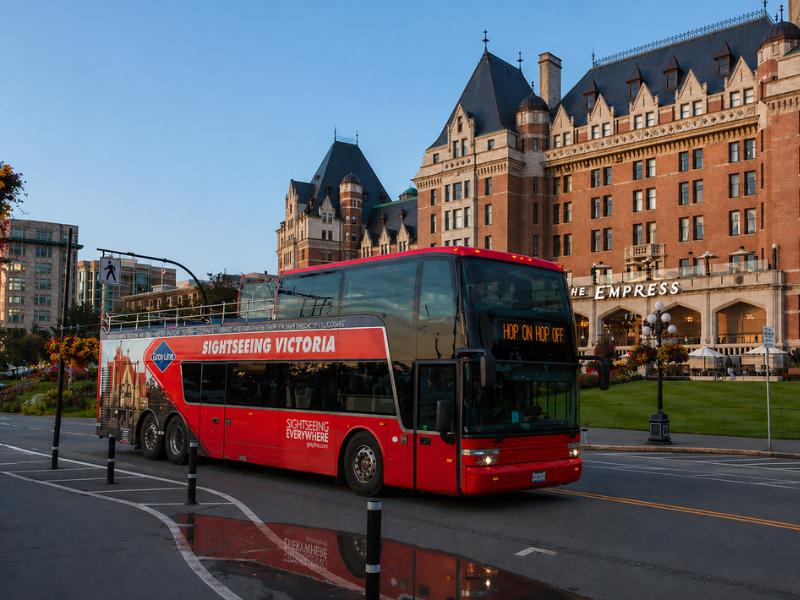
One middle path deserves a mention: walk on, then use a single day tour to cover ground a car would have covered. The open-top hop-on hop-off loop reaches Craigdarroch Castle, Fisherman's Wharf, Oak Bay and Beacon Hill Park across 15 stops, which is most of the reason people bring a car in the first place. It runs rain or shine, and the selected ticket’s validity and last service should be confirmed before planning a second day.
The exception nobody argues with is a genuine island road trip. If your plan involves the west coast, the old-growth forest inland, or anywhere past the Malahat, the car earns its fare several times over and the ferry cost stops being the headline number. Same goes for travelling with someone who cannot manage a kilometre on foot: the walk-on route involves more standing and more transfers than the map suggests, and a vehicle removes all of it. Everyone else is usually paying around $180 extra for the privilege of hunting downtown parking in August.
What does the sailing schedule look like through the day and year?
Sailings run roughly hourly to every two hours depending on the season, with the first departures early in the morning and the last in the evening. Summer adds sailings and holiday weekends add more. Winter thins the timetable, so the gap between departures grows and a missed sailing costs you more time.
BC Ferries publishes the exact times by date, and they change with the season, so the honest advice is to check the published timetable for your travel day rather than trust any pattern printed in an article. What does not change is the shape of it.
| Season | Typical frequency | Practical effect |
|---|---|---|
| Peak summer, late June to early September | Most frequent, extra sailings added | Easiest to day trip, hardest to drive on without a booking |
| Shoulder, April to June and September to October | Roughly hourly to every two hours | The sweet spot: decent frequency, thinner queues |
| Winter, November to March | Fewer sailings, wider gaps | A missed departure can cost two hours |
| Long weekends and holidays | Extra sailings, extra demand | Reserve a vehicle well ahead or walk on |
If you are still choosing dates, the season you sail in changes far more than the timetable. Our month-by-month guide to visiting Victoria lines up weather, crowd levels, whale season and garden pricing so you can pick a window on purpose.
What is the crossing actually like on board?
The vessels are large, stable and set up for a 95-minute sit: indoor lounges with big windows, cafeterias and coffee, washrooms, and outer decks you can walk. Most people never feel the motion. The best part of the sailing is the passage through Active Pass, where the ship threads between islands close enough to see the shoreline clearly.
Getting the most out of it is mostly about where you stand. Head to the outer decks as the vessel approaches Active Pass, roughly midway through the crossing, and watch the water: seals, porpoises and eagles turn up regularly, and on a good day so do larger animals. The guides on the guided Gulf Islands crossing and gardens day tour tell their groups exactly this, because it is the single best viewing window of the trip.
Eating on board is the other efficiency. The cafeteria is nothing special, but a meal during the crossing means your Victoria time gets spent on Victoria rather than on lunch. Bring a layer regardless of the month. The wind on the open deck is colder than the temperature on your phone suggests.
| Comfort question | The honest answer |
|---|---|
| Will I get seasick? | Unlikely on these vessels. If you are sensitive, sit mid-ship on a lower passenger deck and look at the horizon |
| Is there Wi-Fi and power? | Assume patchy. Download what you need before boarding |
| Can I stay in my car? | No, vehicle decks close during the crossing |
| Is there anywhere quiet? | Yes, the forward lounges are usually calmer than the cafeteria |
| Do I need to book a seat? | No, seating is open on the passenger decks |
| What about luggage? | Foot passengers carry bags on. There is luggage storage near the walk-on entry |
Is a guided day tour better value than doing the ferry yourself?
For a single day trip from Vancouver, a guided tour that includes both crossings usually wins on time rather than money. It removes three connections, guarantees you a seat on the coach, and puts Butchart Gardens admission in the price. Doing it yourself is cheaper and more flexible, and better if you are staying overnight.
The comparison below uses the real listed price of the guided option and the ferry figures from earlier in this guide. The tour runs about 13 hours, which sounds enormous until you total up the DIY version and find it lands in the same place.
| Do it yourself, foot passenger | Guided day tour with ferries | |
|---|---|---|
| Cost, one adult | Around $42 return, plus buses, plus garden admission | $210 listed, garden entry and coach included |
| Total day length | Roughly 12 to 14 hours if you want real time in the city | About 13 hours, fixed |
| Connections to manage | Four or more | None, pickup to drop-off |
| Butchart Gardens included | No, buy separately and arrange transport | Yes |
| Flexibility | Total. Stay later, change plans, miss nothing | Fixed schedule, fixed return |
| Traveller rating | Not applicable | Check the current listing |
| Best for | Overnight stays, repeat visitors, tight budgets | One-day visitors who want the gardens without logistics |
Be honest with yourself about which traveller you are. If your Vancouver hotel is booked for the night and you have one day to see Victoria and the gardens, the guided version buys back the hours you would otherwise spend at bus stops. If you are staying two or three nights, the calculation flips and you should go independent. We work through the gardens side of that decision in detail in our Butchart Gardens tickets and hours guide and the shorter answer at can you day trip to Butchart Gardens from Vancouver.
What should you do in your first hours after landing in Victoria?
Head straight for the Inner Harbour. It is where the buses from Swartz Bay drop you, where most tours start, and where the Legislative Buildings, the Fairmont Empress and the harbour walkway all sit within a few minutes of each other. From there, pick one anchor activity rather than trying to cover the whole city on arrival day.
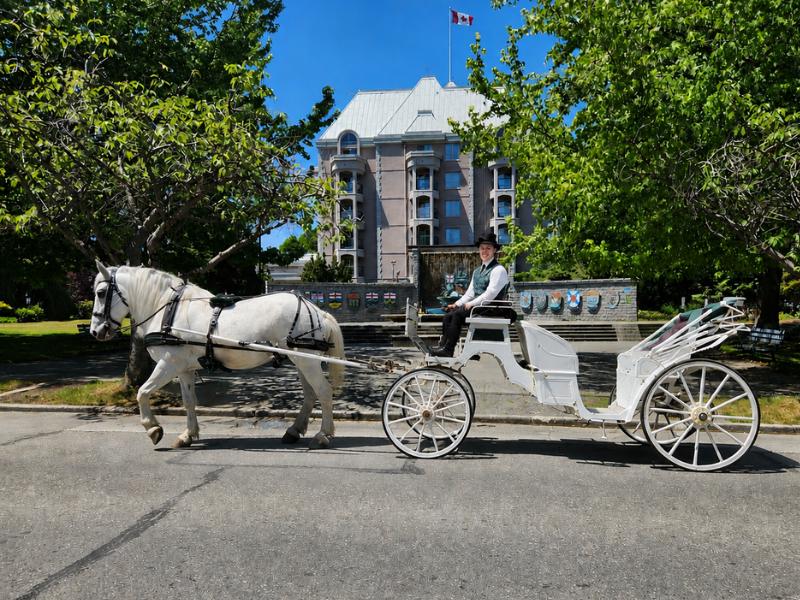
Arrival days are short by definition. If you sailed mid-morning, you are realistically starting the city at lunchtime, which suits a two-hour activity and a long wander. Three things fit that window well. A 75-minute horse-drawn carriage circuit covers James Bay, Beacon Hill Park and the Salish Sea waterfront at walking pace and costs nothing in planning effort, with blankets provided for the breeze off the water. The hop-on hop-off loop takes about 3.5 hours for the full circuit but check the selected pass validity before spreading sightseeing across two days. Or you skip transport entirely and walk, because the core really is that compact.
If you are staying longer, our two and three day Victoria itinerary maps out how the days stack without doubling back. Evening arrivals are a different animal, and things to do in Victoria after dark covers what is actually open once the harbour lights come on.
What do people get wrong on this route?
The five recurring mistakes are all versions of the same error: treating the 95-minute crossing as the whole trip. Underbudgeting the door-to-door time, driving without a reservation in August, booking the last sailing back, forgetting that passengers in a car pay separately, and arriving in Victoria with no plan for the first afternoon.
| Mistake | What it costs you | Fix |
|---|---|---|
| Budgeting 95 minutes for the journey | A missed booking on the Victoria side | Budget 4 to 5 hours door to door |
| Driving unreserved on a summer weekend | One or two sailings of standby waiting | Reserve, or walk on and use a day tour |
| Booking the last sailing home | No margin if anything runs late | Take the second-to-last departure |
| Assuming the car fare covers everyone | An unpleasant surprise at the booth | Add a passenger fare per person |
| Bringing a car for a two-day city stay | Around $180 extra plus parking you will not use | Walk on and stay downtown |
| Landing with no plan for the afternoon | Half your day trip spent deciding | Book one anchor activity before you sail |
None of this is complicated once you see the shape of it. The crossing is the easy part, the connections are where days go wrong, and a single pre-booked activity on the Victoria side turns a logistics exercise back into a trip. If you would rather see everything on offer before you commit, you can browse the full Victoria tour lineup and work backwards from what you actually want to do.