What Is Victoria, BC Best Known For?
Ask ten people what Victoria is famous for and you will get gardens, the Empress hotel, and something vague about it feeling British. All three are true, and each one has a specific reason behind it.
At a glance: Victoria is best known for four things: being the capital of British Columbia, its British colonial-era architecture around the Inner Harbour, its reputation as Canada's Garden City with Butchart Gardens as the headline attraction, and its position as the whale-watching and ferry gateway to Vancouver Island.
What is Victoria, BC best known for?
Victoria is best known for four things: being the capital of British Columbia, its British colonial-era architecture around the Inner Harbour, its reputation as Canada's Garden City with Butchart Gardens as the headline attraction, and its position as the whale-watching and ferry gateway to Vancouver Island.
Everything else people associate with the city, the afternoon tea, the double-decker buses, the hanging flower baskets, grows out of those four. Below is what each one actually looks like when you are standing there.
Why does Victoria feel so British?
Because it was built that way and has kept it. Founded in 1843 as a Hudson's Bay Company fort, the city grew into the colonial administrative centre, and its core still shows that: the 1897 Legislative Buildings, the Fairmont Empress on the harbour, and a stretch of stone Old Town bank buildings that would not look out of place in a British port city.
The look is not accidental preservation either. Victoria leaned into its British character as a tourism identity through the 20th century, which is why the afternoon-tea tradition, the heritage street lamps and the horse-drawn carriages all survived here rather than fading out.
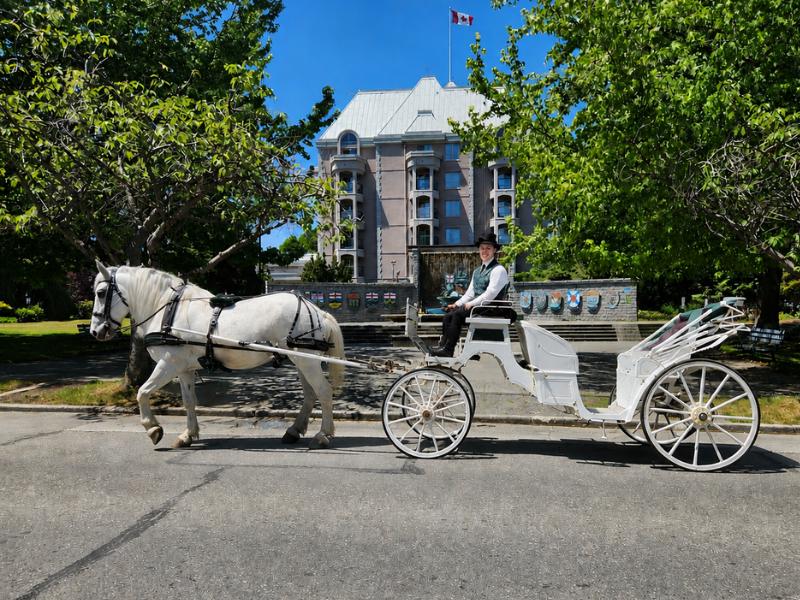
The carriages are the most visible piece of that. A 75-minute horse-drawn carriage tour runs from the Legislative Buildings through James Bay’s heritage homes, Beacon Hill Park and the Salish Sea waterfront, with narration on the city's origins and blankets for cooler days. It is a private carriage for your group at around $285, so it reads as a splurge or an occasion rather than a default sightseeing choice.
What makes Victoria the Garden City?
A mild, unusually dry coastal climate that lets things flower earlier and longer than the rest of Canada, plus a civic habit of planting everything. The nickname is anchored by Butchart Gardens on the Saanich Peninsula, a former limestone quarry turned into a National Historic Site of Canada.
Victoria sits in a rain shadow and is meaningfully drier than Vancouver for most of the year, which is why blossoms arrive here weeks before they do on the mainland. The city runs a flower count in late winter for exactly this reason. Downtown lamp posts carry hanging baskets through the warm months, and Beacon Hill Park spreads over about 200 acres of gardens, ponds and old oaks right on the edge of the core.
Butchart is the reason most first-time visitors come. Adult admission runs roughly $42 to $46 in spring, about $44 in peak summer, and drops to around $29 to $37 in October and November. The Christmas Lights season from December 1 runs afternoons into the evening and is a distinct experience from a summer visit. Check the current season's prices and closing times on the gardens' own website, and our Butchart Gardens visitor guide covers the planning. Without a car, the guided Butchart Gardens tour with entry tickets is the straightforward way in, five hours including a city circuit and 2.5 hours in the Gardens for around $106.
Is Victoria really the capital of British Columbia?
Yes, and it surprises people constantly, because Vancouver is far larger and better known internationally. British Columbia's legislature sits on the Inner Harbour in Victoria, in the domed 1897 building lit up at night, and the province has been governed from here since before Vancouver existed as a city.
The practical effect for visitors is that Victoria's core is a government town rather than a business district. It is low-rise, historic and quiet after office hours, which is a large part of why it feels more like a European harbour town than a North American city.
What else is Victoria known for?
Whale watching in the Salish Sea, one of North America's oldest Chinatowns, the float homes at Fisherman's Wharf, and a food and craft-beer scene that punches far above the city's size. Those are the four things visitors most often name after the gardens and the architecture.
Every operator named here is one Victoria BC Tours already lists, with live prices shown on their own booking page.
The whales are the big one. Orcas, humpbacks, minke and gray whales move through the waters off Victoria, and the season runs roughly April through October. Our whale watching season in Victoria guide breaks down what shows up when.
Chinatown is the oldest in Canada, centred on Fisgard Street and the Gates of Harmonious Interest, with Fan Tan Alley running narrow between the buildings. Fisherman's Wharf is the cluster of brightly painted float homes and seafood stands a short walk from the harbour. And the food scene is why two separate walking food tours operate here; we cover it in our post on Victoria's famous food.
| Known for | Where you see it | Time needed |
|---|---|---|
| Colonial-era architecture | Inner Harbour, Legislative Buildings, Old Town | 1 to 2 hours on foot |
| Garden City reputation | Butchart Gardens, Beacon Hill Park, downtown baskets | Half a day for Butchart |
| Provincial capital | The 1897 legislature on the harbour | 30 minutes, free to view |
| Whale watching | Salish Sea, boats from the Inner Harbour | 3 hours |
| Historic Chinatown | Fisgard Street, Fan Tan Alley | 45 minutes |
| Float homes | Fisherman's Wharf | 1 hour with lunch |
Is Victoria known as a cruise stop?
Very much so. Ogden Point, a couple of kilometres from the Inner Harbour, is one of the busiest cruise terminals on Canada's west coast, and a large share of visitors see the city on a port call of a few hours rather than an overnight stay.
That shapes what the city offers. Short walking tours, harbour excursions and half-day garden trips all exist because they fit inside a port window. If that is your situation, our cruise port guide lays out what genuinely fits three, five or eight hours ashore.
What is Victoria not known for, honestly?
Big-city nightlife, skyscrapers and dramatic mountain scenery inside the city limits. Victoria is compact, low-rise and early-to-bed compared with Vancouver, and visitors expecting an urban capital in the usual sense are often surprised by how small and quiet it is.
We say this because managing that expectation makes for a better trip. The city's strengths are its scale, its water, its gardens and its history. Treat it as a walkable harbour town with world-class gardens attached and it delivers. Treat it as a substitute for Vancouver and it will not.